Thursday, 22 October 2009

Friday, 16 January 2009

ONLINE

Ok, the website is now up and running under:


It might also appear under another address but, for now, I think they have block me for exceeding the transfer allowance this month. It will be automatically unblocked at the beginning of February.

Some more screen shots

This is a part of an introduction movie. After being asked whom is the user looking for, he/she can see these tiles. They are all rollover buttons. With the mouse cursor placed on a tile, the user can see a picture of me in colorful attire and another word such as creative, imaginative, flexible etc. On click, the button takes the user to my homepage.


This is a home page that appears after a user clicks on any tile. What is interesting here that where is says "My name is Katarzyna Matuszewska and this is my Creative Portfolio" the text is converted to rollover button, which explains that you can click on it to hear the pronunciation of my name.

I also used a similar button on the header of every page so whichever page user is looking at he/she always has an option to hear my name!


This is a website design page. The boxes on the left are buttons which take the user to an external website (my last year's project in digital media), show a quick preview of that project, or show a mockup homepage of another project.


This one is a print design page. The user gets to choose between two publications I've been working for. The cover pictures and the text boxes are buttons which, when clicked on, allow the user to browse inside the magazine. He/she can view those pages in the mag that I designed and navigate through them using next, previous and close buttons below.


Tuesday, 13 January 2009

Web uploading problems

I've been experiencing some problems with the web host, therefore, my website is currently unavailable of the net. Trying to resolve is soon as I can.

Monday, 12 January 2009

New Web Address


Well, I had to change the URL address of my site because the previous one had this awful adds right at the top of a page which really spoiled the design concept. I contacted  the administrator to find out if there is a way to remove them and he told me that if I don't want adds I can always upgrade (which is paid, certainly). Moreover, trypod.com does not support php files which was necessary for the contact form to work properly. I wouldn't be able to receive any of those interesting comments you are going to send me.

I remained in touch with the creator of the contact file and he recommended that I use another host and he emailed me the entire list of different sites that provide this type of service. I tried many and picked this one because of the domain name I'll be using, which is 


It wasn't without it's complications. I was very confused with the URL I was given on a permanent bases (until the domain is activated). It all worked but the URL address contained 10-digit number and nothing to do we me or journalism. I contacted the administrator then, who fixed the problem within 5 minuts. As a result, I have my site, my cool URL address and a free host. 


Sunday, 11 January 2009

My site URL

I was just trying to find a server that I could upload my site to but although everyone claims it's free they all charge either for domain of for web hosting. Well I bought a domain matuszewska.me.uk but don't know what to do with it next. I also followed a friend's recommendation and signed up for tripod.lycos.com and even managed to upload some pages in progress just to be sure it works. 

My website address is http://k0624363.tripod.com/
The only thing I don't like is that there are some ads right at the top of my page and I don't know if I can get rid of them...

Saturday, 10 January 2009

Screen shots

What I like most in digital media project like this is learning new clever things. Everyday I find something interesting in my own Mac that I did not know earlier. Today I've learned how to use screen shot. It's a pity I couldn't do that before so I could show my work in progress. Well, I will start now....
All the pages so far have been created in Flash and, with addition of header and menu bar, embedded into Dreamweaver.
This is a gallery page I've done before Christmas. By clicking on the
 thumbnail images on the top of the screen the user can see the large image. Under every big image there is a line of text which reads: (1) Self-portrait ... because everyone has a second countenance, (2) Being different means being unique, (3) And the sky is the limit, isn't it?, (4) So if you hold your head high and stand up to the challenge, (5) ... all your dreams will fall to your feet, (6) You just have to believe that everything is within your arms' reach! It is like a little motivational talk... 


The second shot is of a news page. I really regret I cannot show how much it improved since I started working on it in December.  It looks much more professional now, less boxy I mean. 


This is a shot of a features page. It is more colorful and funky than the news page but it is supposed to be more magaziny... I had a lot of fun with this one.


And this is my favorite one! It is the most funky contact page you have ever seen!!! When you type something on your keyboard the letters that you see on the bottom jump up straight into the boxes. Unfortunately, I don't take a full credit for that. I downloaded it from FlashDen just like the menu bar before. But I did customized it myself. I added the drawing... cool!

Free Fonts Downloads


Whatever your design needs are, you're sure to find plenty of funky fonts for free on 1001freefonts.com

Monday, 15 December 2008

Use Akvis Sketch to convert a photograph into a full-colour drawing

For those of you who spend hours trying to convert a photograph into a full-colour drawing - just simply download Akvis Sketch application and do the conversion in just a few easy clicks. It's fun and it's free!!! 

Download Flash Elements

Driven by ambition of having professionally looking website and a chronic lack of time I decided to use a navigation bar downloaded from a FlashDen.net website. And it is not to say that I cannot create one by myself but to hint towards the fact that professional web developers often use this type of services to save time for other things. Why would one want to invent a wheel again?

I have paid to download a two level navigation bar but I found it difficult to understand the way it can be edited (fonts, colour, etc.) and actually used on my flash stage. And well, after hours wasted trying to solve the problem independently and another couple of hours with the tutor's (Maria) help the bar was fixed and ready to use. Well done to all involved...

To see the original navigation bar preview click here.


Thursday, 11 December 2008

Watch out: Flash CS4 only for the courageous!


After I bought my new Macbook and decided to equip it with Adobe software and this was the time when  I realized that Adobe has already launched a new version - CS4. I thought: 'Well..., this is an investment in future. Sooner or later everybody will update to the newer version and I will be already familiar with it. And, how much difference working on a newer version of Flash will make to me - I am nearly an expert anyway'. I could not be more mistaken!

Making the simplest animation such as a shape moving from left to the right, fading in or out did not work. Why??? Why??? Why??? - I kept banging my head against the wall.

For those of you who are ever going to upgrade to Flash CS4: do not create a new keyframe for animations, Flash will make it for you. Look up at these Kirupa tutorials.

Conclusion

This tutorial was a broad overview of some of the animation features you have in Flash CS4. If you are familiar with previous versions of Flash, none of the terminology in here was particularly new. What was new is how you actually created your animation.

In the past, you had an instance of your object at your starting point and another instance of your object at the end point. You also inserted two keyframes to represent that. The tweening system calculated the differences between those two objects and presented them to you.

By default, animations you now create in Flash CS4 are property-based where the properties of your object are modified over a period of time. You have the same object throughout the lifespan of your tween, and at various points in time, the properties that make up your object are altered instead of the actual object itself. In our example, it was our image's X and Alpha properties that were changed over a period of time. That seems trivial and the end result doesn't look dramatically different, but this is a major change that this tutorial does not even attempt to address.

Future tutorials will focus on that change and other parts of the animation functionality in CS4, so with that, here is the source file for the animation you just created:

Wednesday, 10 December 2008

Free photo library


I just found an amazing site with fantastic images in print quality. All free and available for all sort of publications. No fees, no copyright!!! You even find photo-tips and Photoshop tutorials. All you need to do is register.  Highly recommended!

Business Card Design


Last night I have come up with a business card design. It is rather simple - I know - but than I want to use this card in real world. After graduation I might be doing some journalism freelancing and I will need a business card so I plan to use this one. It is simple but simple does not mean bad, does it? I think it looks quite professional. 


There is another, slightly different version. It is still subject to change. Feedback and suggestions appreciated. 


Tuesday, 9 December 2008

Removing background with a doctor's precision

After hours and hours of trying to remove the green screen background from my photo session pictures using the hit-and-try method I managed to develop the procedure that seems to work. It also seems to be very complicated but I really cannot think of any other way to do it. Once I've done few pics I think it still is laborious and time-consuming but also doable. 

This is the procedure:
  1. Open the picture in AfterEffects, shorten the timeline to 1 frame only and remove background using Effects-Keying-Keylight. Change the screen color to white, adjust picture grain and balance.
  2. Export the image as png file (not jpeg, for some reason if exported as jpeg the background remains black while if exported as png the background turns light grey). 
  3. Open file in preview (again if you simply open it in Photoshop the background goes black again) and save as jpeg.
  4. Then the jpeg file is ready to be edited in Photoshop. Remove the background completely using magic or quick selection tool. 
  5. Once the background is transparent save as psd file and jpeg file (you will need to overwrite the previous jpeg picture if saved with the same name - it is not needed anymore and saving all format off the same picture with the same name will help to keep the files organized).

Monday, 8 December 2008

Poster Design

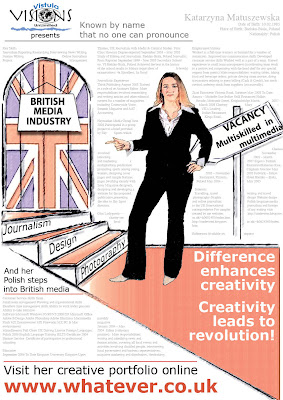
I have spent the last couple of days designing a poster for my project. Despite the extensive experience in InDesign I posses I still found it extremely difficult and time-consuming.

I also find having to work on the images of myself a little bit intimidating. I feel like I lose the sense of visual objectivity when I work with my own images. It just feel so strange...

Anyways, due to my other university
 commitments I had very little time to work on my project lately and today I had to show my work in progress to the rest of the class. I did not have much so having design the poster that was the most important part of my presentation.

I think that in overall Maria liked the poster but she suggested the the picture of me being close to the original image and simply pasted into the poster drawings of stairs and doors looked a bit out of place. I do agree with that comment and I was looking for a way to adjust the picture so it look like drawing too and is consistent throughout. 

I have tried different filters in Photoshop and InDesign but nothing
 seemed to work. I thought I have to find an alternative so I googled for tutorials on how to convert a photograph into a color drawing. I found something called Akvis Sketch. I have never heard of this software before but it looked pretty straight forward, easy-to-use and effective way of converting the image so I gave it a go and downloaded it. 

Here is a corrected version of the poster. I believe I will still need to change it later as it should include the module name and code but I will leave it for later stage of production processes.


Sunday, 7 December 2008

Problem after problem

After I finally found time get kick start my project (it's already November and I have not done much so far) the inevitable happened I straight away I begun to have problems. 

The only reason I decided to do a photo session in the studio (318B) was to use a plain screen and be able to cut out the background from the pictures. But it proved to be a challenge! When I used the magic wand in Photoshop it either left me a green edge around me or cut off a part of my hair. Egle who was working next to me advised that I AfterEffects for it but as I never worked with it before I did not know how to do it. She showed me but it was not a magic touch, rather time-consuming and when I though of doing it with ALL my pictures (I have got dozens) I started panicking. 

I was trying to find a way to resize and remove background from all the pictures at the same time but nothing I tried (Photoshop, AfterEffects, etc.) worked. Someone people felt that the background does not look that bad at all but I was desperate to get rid of it as I planned to import separate pictures into individual frames in Flash so when played it looks like a stop-motion movie. Someone advised me that I can simply use Windows movie maker to make that very simple movie. I thought that it was not so good idea but decided to give it a go. As I work on mac I opened iMovie and found effects that you can apply to the pictures that melt the background. But it still looked cheesy and was a sort of solution for the beginning scene only. On the home page when my picture is supposed to be surrounded with colored menu bars this would not work!

I just want white background on ALL my pics!!! Any help???

So finally I thought that I cannot change unchangeable and decided to narrow down the number of pictures that I will use for the project and remove the background using traditional method it Photoshop (or AfterEffects with someone's help).

Also, I had planned to use bitmap tracing to make the British mask change into a Polish mask. Mask only as oppose to the whole picture. And I did not managed to execute this idea either!

On the top of all this, after spending the entire day and evening in the computer lab I wanted to save whatever work I have done to my memory stick. And my memory stick decided to stop working just like this! I have emailed the files to myself eventually so nothing was lost but the fact that even technology turned against me that day only added to my frustration.
 
Yes, all this made me feel rather frustrated and demotivated. This isn't the way I've planned it!!!

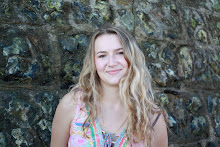
Anyways, this is what I ended up with after two hard days! And please, do not laugh - I know I am not a miss world and having my photo on the screen makes me feel at least weird...

Wednesday, 5 November 2008

Storyboard for the introduction

All created in Flash, using my own images edited in Photoshop:

Black screen and a question in white: "Whom are you looking for?" - a question that I ask a potential employer visiting my site.

  1. The image of me dressed as professional (formally: white shirt, black jacket, etc) on the left side of the screen and words relating to different attributes sliding from the right side of the screen: someone ambitious and professional, highly organized and motivated, reliable and well-fitting into your organization... etc.

Then, as that disappears, the image of me dressed as an artist appears on the right side of the screen and the words are sliding from the left: someone creative and spontaneous, flexible and imaginative, original and fresh-minded... etc.

The two above images could appear on the screen mixed and in short slots with a different text every time and maybe I could take slightly different pose to make it more dynamic.

Then, as another prompt shows up: "Both?", the two images merge in the middle of the screen and I (half formal, half artist) introduce myself. While I pronounce my name it appears on the screen along with phonetic pronunciation).

A picture of me, a close up on my face (no eye contact) with a half transparent mask in British flag's colours. Prompted answers: Someone highly qualified with the knowledge and the understanding of British media industry?

Using Bitmap tracing the British flag turns into a Polish flag. Different prompt appears: Someone with an international perspective and experience?

I present the key areas of my portfolio. The series of images taken at three-frames-per-second imitates the motion as I raise my arm to point towards the menu for journalism on the left, design and photography on the right appearing on the screen one by one. Maybe a colourful, half-transparent brash continuous to move at the background as everything else freeze.

While all the above plays out there are 'Skip' and 'Silent' buttons on the bottom of the screen which user could use to skip the presentation or turn off the sound.

Tuesday, 4 November 2008

Moving images idea!

At the beginning of september I went for a short trip to Brighton mainly in order to test my new digital SLR camera. I was just downloading the images taken that day onto my computer tonight and when I was viewing on as a slide show I came up with an excellent idea.

Using my new camera I can take up to three pictures per second. I could use this feature to create a series of images of me that when played one by one in flash, for example, would create an illusion of a video. I could combine it with different graphic elements on different layers in flash and make something like a movie, set in virtual space! I could record my voice welcoming a viewer on my online portfolio website and introduce the key issues my project intend to tauch.

I can imagine myself lifting my arm sideways to present to menu appearing on the side 'as a result' of the movement. It's difficult to describe in words how I see it at the moment, however, I strongly believe that such an original introduction to my website would add a real edge to the final product. It would be something nobody else thought of before: the unique combination of creativity and journalistic protectionism.... and, most importantly, an excellent form of self-promotion.

Saturday, 25 October 2008

Project Proposal

The inspirations: theoretical framework of the project

To a large extend, this project is based around my personal reflections about the contemporary media and the creative industry. As a final year student of journalism with media and cultural studies I begun to think about my future career, the opportunities I had and those I did not.

The project idea arose around certain issues widely discussed by scholars of contemporary media and cultural studies. Firstly, the fact that the development of new media technologies led to the transformation of mass media into ‘new media’ characterised mainly by their interactivity and digital distribution. Secondly, there is a notion of self-representation of an individual within postmodern, performative society. Finally, there is a problem of under-representation of ethnic and national minorities within mainstream media and inequality that individuals with non-English background need to face to get into media industry as professionals. The product I intend to create will be, to some extend, my response to those issues.

I am a representative of a generation that grew up surrounded by mass media technology (TV, radio), matured in digital environment (the Internet, digital imaging, etc) and is now about to enter the world of computerised and digitalised media industry as professionals.

In the last twenty-five years the media has been rapidly transformed into ‘new media’ based on digital, computerized, or networked informatin and communication technologies. New media are not only interactive and digitally distributed but also they are characterised by the extensive use of the Internet and the integration of text, pictures, sound and video. Even traditional ‘old’ media forms, for example the printing press, have been transformed through the application of technologies, such as image manipulation software like Adobe Photoshop and desktop publishing tools.

In new media environment the distinctions between interpersonal and mass communication and between public and private communication have been blurred and the meaning of geographic distance has been altered allowing a huge increase in the volume of interactive and fast communication and allowing forms of communication that were previously separate to overlap and interconnect (Neuman 1991).

The new media communication technologies enable or facilitate user-to-user interactivity and interactivity between user and information. Internet, for example, replaces the “one-to-one” interpersonal communication model and "one-to-many" model of traditional mass communication with the possibility of a "many-to-many" model of communication. Any individual with the appropriate technology can now produce his or her online media and include images, text, and sound about whatever he or she chooses.

Mass media saturated, postmodern society demands from individuals to project their identities all the time. Abercrombie and Longhurst (1998), in their influential study of audiences, introduced the concept of 'diffused audiences'. They argued that we (consciously or not) consume media all the time. More importantly, media’s interactivity causes the boundaries between the audience and a performer to blur.

According to Abercrombie and Longhurst, "life is a constant performance; we are audience and performer at the same time; everybody is an audience at the same time" (p.73). We are all performers acting accordingly to social rules and conventions and projecting ourselves and our identities to the others. "Human society itself is theatre," they claimed (p. 73). Postmodern society is highly performative and the media of mass communications provide an important resource for everyday performance. Our identities are represented in the media (for example, MySpace and Facebook) and through our use of the media (movies, TV programmes and music we like).

The notion of diffused audiences arises from the interaction of two processes: the construction of the world as spectacle and the construction of individuals as narcissistic. Abercombie and Longhurst noticed: "Spectacle and narcissism feed off each other in a virtuous circle, a circle fuelled largely by the media and mediated by the critical role of performance" (p. 75).

Therefore, being a member of the performative society and an aspiring performer of mass media I seek to manifest myself, my identity, skills and interests through my online creative portfolio. I believe that self-representation in the media is a necessity and creating an online portfolio is an inevitable step on the way to digitalized creative media industry which nowadays works, communicates, exhibits and recruits online. I am aware, however, that as a representative of national minority I face constant barriers in my attempt to become a professional mass media performer: a journalist, a designer or a photographer.

Traditionally, British media institutions have been dominated by white, middle class, predominantly male individuals. This often results in minority groups being underrepresented within media, having fewer opportunities for voicing their concerns and reaching the public as well as fewer opportunities for careers in the mainstream media.

The problem of under-representation of ethnic minorities within media has been widely discussed. Ono of the most significant examples of action taken to address the problem is EMMA (Ethnic Multicultural Media Academy) founded in 1997 by Mr Bobby Syed who realised that although Britain is a multicultural nation, this diversity is not reflected in the mainstream media industry. The EMMA Awards were created to recognise and honour humanitarian media excellence.

The minorities tend to create an alternative media to represent British multiculturalism (Fraser 1991, Dahlgren 1995, rnebring and J nsson 2004, Temple 2005, Atkinson and Dougherty 2006). Thanks to the Internet, a massive diversification of media occurred. Millions of websites, forums, blogs and wikis have been created and that evolution, often labeled ‘citizen journalism’ or ‘citizen media’, makes it possible for practically everybody to be a media creator, owner and actor, instead of a passive user. Citizen media gradually take audiences out of the traditional media and weaken the role of information professionals. They cannot, however, function with the same kind of in depth reporting that brick-and-mortar organizations have, in the form of funded research and expert analysis.

Moreover, I tend to believe that ‘national minorities’ as oppose to ‘ethnic minorities’ still struggle to gain recognition within mainstream and alternative media. People like me, ethnically white migrants from other European countries, do not have equal chances for careers in media. The language is perceived to be the main reason for that inequality. It is commonly assumed that a journalist needs to be a native English speaker in order to be successful in British media. I do not agree with this opinion and wish to challenge this stereotype in my project.

The concept and the product description

I intend to create an online portfolio of my works in different areas of creative industry: mainly journalism, graphic design (for web and print) and photography. I aim to develop a website which could be used as a framework and a platform to exhibit examples of my work. It will be regularly updated with articles, photographs and designs I will create in the future. It will be dynamic (flash interface) to show creativity but simple at the same time (content over form not the other way round) to demonstrate professionalism.

The online portfolio in a form of a website remains flexible way of presenting my work and is open for further expansion. There are many types of work I could incorporate into the website, such as articles (text), designs (graphics), interviews (audio), documentaries (video), photographs (images), etc. Contact details as well as on-screen and printable versions of my CV will be displayed.

The project will be exhibited online and the link to the website will be used as an attachment to my further job applications.

My project will work on two different levels. Firstly, it will demonstrate my interests and skills, and try to sell them to potential employers. Secondly, it will take a side in a discussion about media diversity or its lack.

Project identity

As my project will take a form of a self-promotional portfolio I intended to brand it with my own name. However, taking into account that my foreign name is extremely long, difficult to pronounce and memorise I came up with an abstract name: Vistula Visions UnLimited. ‘Vistula’ is the name of the longest Polish river and refers to my national origin and background. The word ‘Visions’, together with a shape of an eye and a glob in it, refers to the certain perspective which a journalist, a photographer or a designer coming from diverse background can incorporate into his/her work. The word ‘UnLimited’ refers to an attempt to break the boundaries traditionally existing between English and non-English journalists within British media institutions.

References

Abercrombie, N. & Longhurst, N. (1998) Audiences: A Sociological Theory of Performance and Imagination. London, Thousand Oaks & New Delhi: Sage.

Atkinson, J. & Dougherty, D.S. (2006) ‘Alternative Media and Social Justice Movements: The Development of a Resistance Performance Paradigm of Audience Analysis’, Western Journal of Communication. 70(1):64-88.

Dahlgren, Peter (1995) Television and the Public Sphere. Citizenship, Democracy and the Media. London, Thousand Oaks & New Delhi: Sage.

Fraser, Nancy (1991) ‘Rethinking the Public Sphere: A Contribution to the Critique of Actually Existing Democracy’. In Calhoun, C. (ed.) Habermas and the Public Sphere. Cambridge, MA: MIT Press, pp. 109-142.

Neuman, R. (1991) The Future of the Mass Audience. Cambridge: Cambridge University Press.

Ornebring, H. & Jonsson, A.M. (2004) ‘Tabloid journalism and the public sphere: a historical perspective on tabloid journalism’, Journalism Studies. 5(3):283-295.

Temple, M. (2005) Multi-dimensional public spheres: In praise of ‘dumbing down’. Paper presented to the Political Studies Association Annual Conference on 5-7 April 2005 at Leeds University.